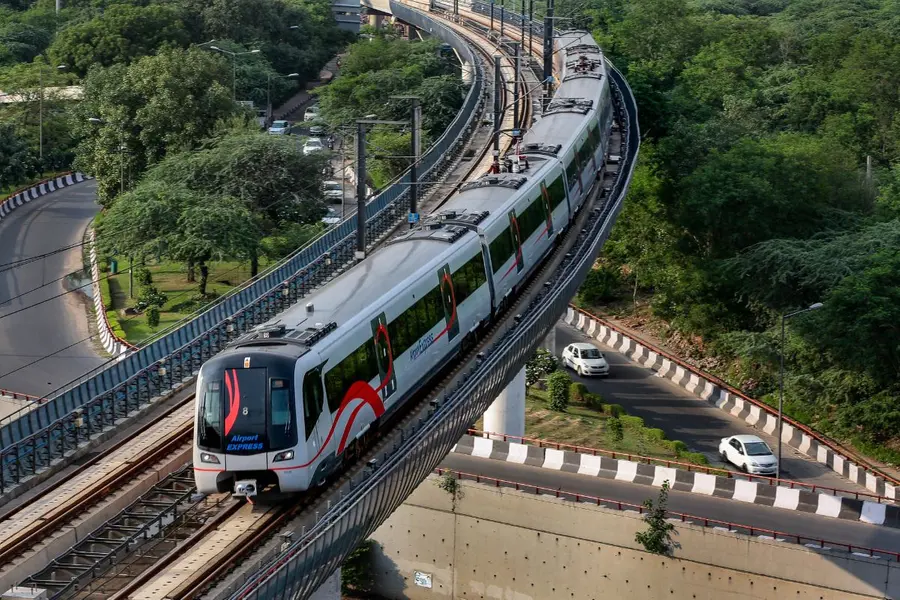
Delhi’s expanding metro grid is set to gain an engineering first with the development of a multi-level interchange at Nabi Karim that will allow passengers to switch directions within the same corridor. The station, part of the extended Magenta Line, is being designed as a looped junction where the alignment intersects itself a configuration rarely seen in Indian rapid transit systems.
Officials at Delhi Metro Rail Corporation confirmed that the Nabi Karim station will function as an intra-line interchange, enabling commuters to transfer between two segments of the Magenta Line without exiting the system. The design responds to the integration of multiple sanctioned extensions that are reshaping the corridor into the network’s longest route.Once completed, the Magenta Line will stretch from Botanical Garden to Inderlok, nearly doubling its current operational length. Urban transport planners note that the restructuring reflects a shift towards orbital and cross-city connectivity, reducing the need for passengers to travel into central interchange nodes for directional changes.
The Nabi Karim station will be developed across several underground and elevated levels. Transport authorities have indicated that commercial floors and structured parking will be incorporated above ground, with capacity planned for thousands of vehicles. The site spans roughly 26,000 square metres, positioning it as both a mobility node and a mixed-use urban asset.A senior metro official explained that the alignment from Janakpuri West to RK Ashram Marg and the further extension towards Indraprastha and Inderlok will converge at this location on different vertical planes. This layered configuration means the same station name will appear twice on the route map, each serving distinct travel directions along the Magenta Line.
The expansion is unfolding in phases. Under the current construction cycle, the Janakpuri West–RK Ashram Marg stretch is progressing, while additional links under Phase IV and Phase V(A) will formally integrate central Delhi corridors into the Magenta Line. The corridor is also set to host 21 interchange stations, the highest on any line in the capital’s network.For the city, the Nabi Karim station signals more than operational convenience. Transport economists say intra-line interchanges can shorten travel times and distribute passenger loads more evenly, improving system efficiency while reducing congestion at legacy hubs. In dense districts, such design also supports transit-oriented development concentrating housing, commerce and public amenities around high-capacity transport.
Delhi’s metro network has become central to its low-carbon mobility strategy, carrying millions daily and offsetting substantial road emissions. As the Magenta Line evolves into a near 90-kilometre spine, infrastructure experts argue that design innovation must go hand in hand with equitable access, pedestrian connectivity and last-mile integration. With work underway, the success of the Nabi Karim station will depend on seamless construction management and coordination with civic bodies. If delivered as planned, it could set a precedent for how rapidly growing cities reconfigure transit lines to meet rising demand without expanding their carbon footprint.