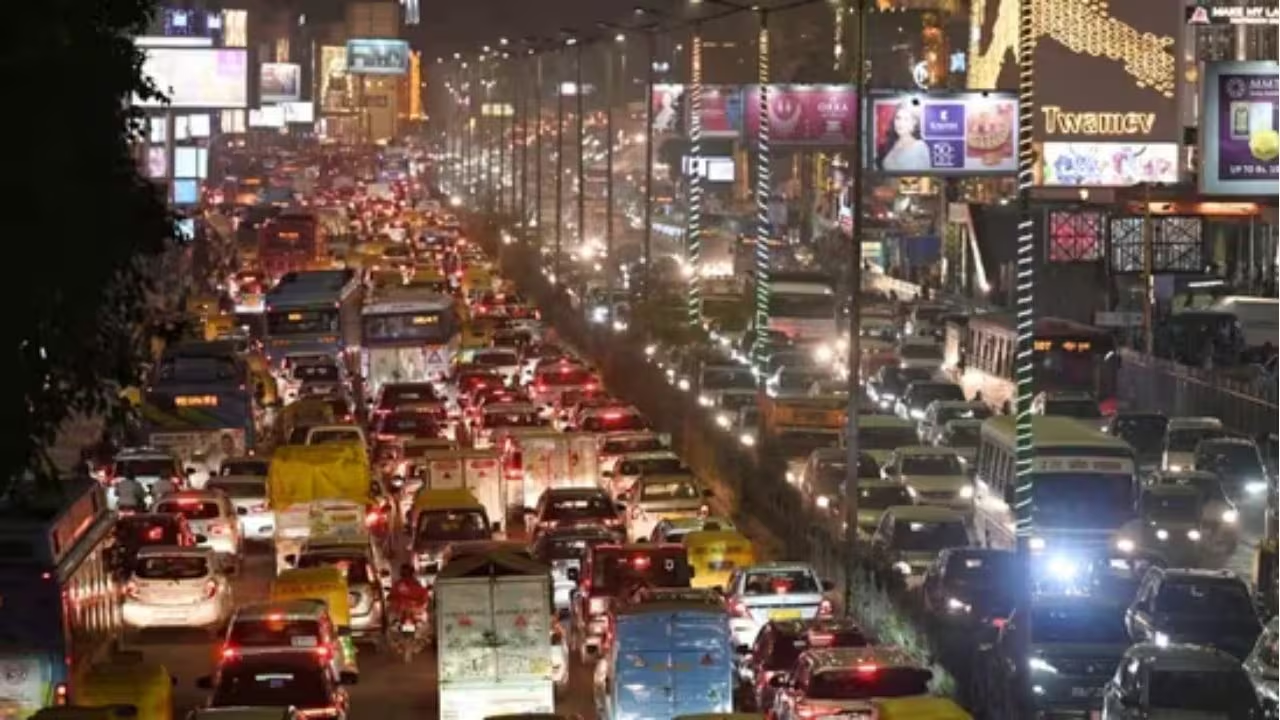
Delhi’s aviation gateway has advised passengers to shift to rail-based access as large-scale events in the capital are expected to slow road movement around the airport precinct. With thousands of delegates converging on Bharat Mandapam for the India AI Summit, authorities have cautioned that peak-hour congestion could affect surface travel times to Indira Gandhi International Airport.
The Delhi Airport advisory, issued on Sunday morning, recommends that flyers factor in additional commute time and consider using the city’s metro network. Airport officials indicated that Terminal 1 is best accessed via the Magenta Line, while Terminals 2 and 3 connect directly to the Airport Express corridor, which links central Delhi with the aerocity district.Urban mobility specialists say such advisories reflect the increasing pressure that mega-events place on metropolitan transport systems. “Delhi’s core business and diplomatic districts are dense, and road-based travel becomes unpredictable during international summits,” noted a senior transport planner familiar with city operations. “Encouraging mass transit use is both efficient and environmentally prudent.”
The AI Summit, hosted for the first time in India’s capital at this scale, has drawn global technology firms, startups, policymakers and research institutions. Organisers expect hundreds of thousands of visitors over five days, with more than 500 knowledge sessions and several hundred exhibition pavilions spread across 70,000 square metres. Beyond the conference halls, the convergence highlights how infrastructure readiness shapes the city’s economic competitiveness. Aviation hubs are critical nodes in global value chains, and even minor delays can ripple across supply networks, business meetings and tourism flows. In this context, the Delhi Airport advisory underscores the importance of integrated, multimodal transport planning in high-growth urban regions.
The summit also aligns with India’s ambition to expand its artificial intelligence market, projected by industry analysts to cross USD 17 billion by 2027. With a vast digital user base and a rapidly scaling startup ecosystem, the country is positioning itself as a laboratory for population-scale AI deployment from precision agriculture to accessible education platforms.However, the logistics challenge surrounding the event also offers a reminder: technological ambition must be matched by resilient urban systems. Delhi’s metro network, now spanning over 390 kilometres, has become central to reducing vehicular emissions and easing congestion in a city that frequently battles poor air quality.
As more global gatherings choose New Delhi as a venue, transport authorities may need to institutionalise event-responsive mobility plans integrating airport operations, metro scheduling, traffic management and real-time passenger communication. For residents and travellers alike, seamless access is no longer a convenience but a prerequisite for a city aspiring to lead in both innovation and sustainable urban growth.
Delhi Airport Flags AI Summit Traffic