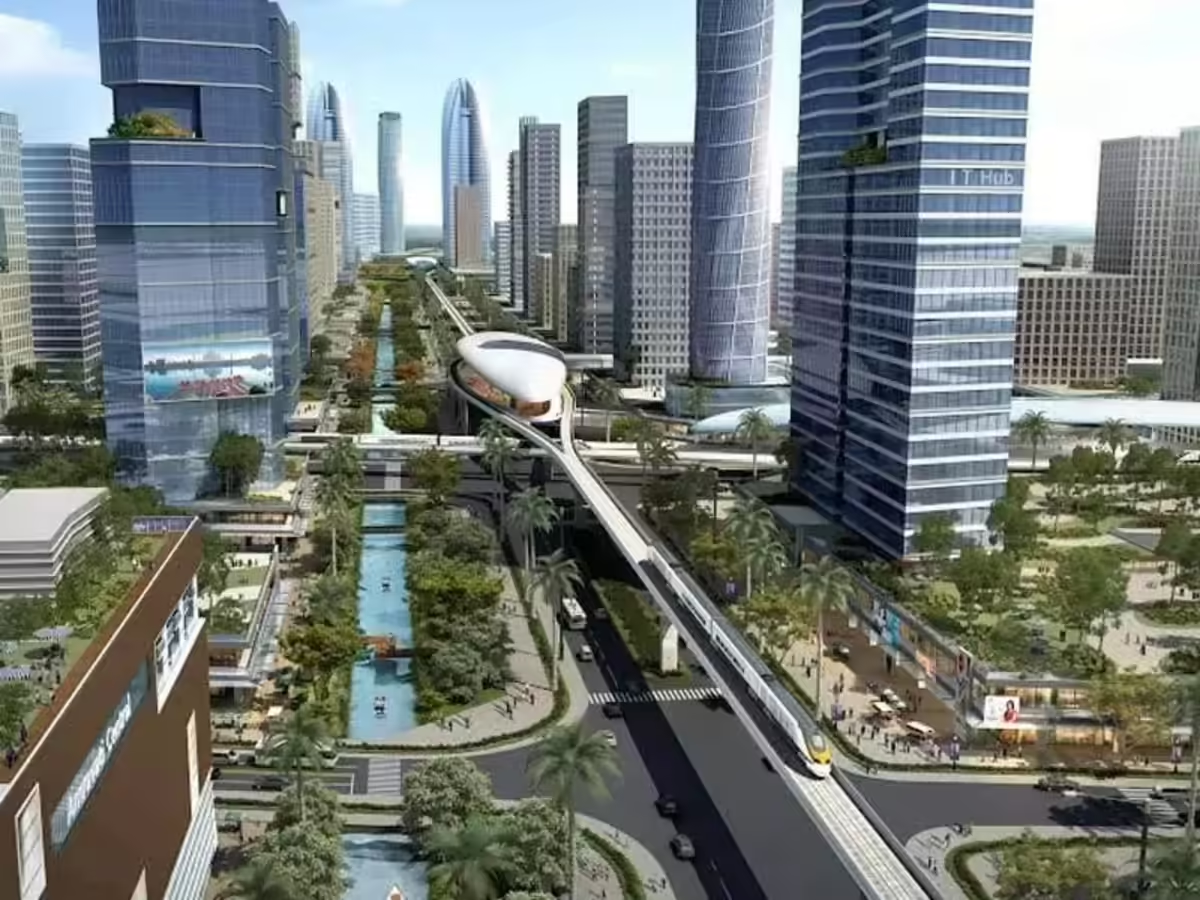
Nagpur, Maharashtra — The Nagpur region is being positioned as a central growth engine for six adjoining districts, with state leadership emphasising a decade-long strategic approach to equitable, sustainable development anchored on Nagpur city’s unique geographic and economic strengths.
The vision emerged from a workshop on regional planning, co-hosted by the Maharashtra Institution for Transformation (MITRA), the Asian Development Bank and a leading global consultancy, highlighting an effort to recalibrate development patterns in one of India’s fastest urbanising areas. In remarks to stakeholders, the Maharashtra chief minister underscored that the region’s “central location and natural resources” provide a compelling basis to leverage Nagpur as a nucleus for holistic growth, rather than concentrating development only in major coastal hubs. The acknowledgment of “lopsided growth” across the state reflects long-standing policy challenges where wealth and infrastructure have clustered in a few metropolitan areas while interior districts lag behind. The regional strategy workshop focused on articulating measures that encourage balanced economic expansion, inclusive job creation, and improved service delivery across Vidarbha’s six districts, which currently exhibit varying development indicators compared with Maharashtra’s western and coastal belts.
Planners at the forum argued that urban centres like Nagpur can catalyse growth in adjacent districts through better connectivity, innovation ecosystems, and integrated infrastructure platforms. Urban economists say the region’s future hinges on advancing multimodal connectivity, fortified institutional frameworks, and sector-agnostic investment strategies that transcend traditional urban–rural divides. Transport corridors, logistics links and digital connectivity are considered pivotal in linking manufacturing, services and agriculture clusters across the hinterland to metropolitan demand centres. This integrated approach is a departure from siloed planning models and aligns with broader national priorities on spatially inclusive development. Complementing this regional thrust, the state government has in recent months unveiled flagship economic initiatives that reinforce Nagpur’s strategic role. A long-term sustainable development blueprint envisages significant private sector investment, industrial clustering, and job creation within sectors such as defence, minerals and high-value services.
This expansive roadmap is designed to harness local competitive advantages while mitigating environmental and social externalities. Planners caution, however, that translating strategic vision into tangible outcomes requires robust governance reforms at municipal and district levels. Strengthening land-use planning, streamlining approvals, and fortifying public service delivery systems are seen as preconditions for scaling development without compromising environmental and social resilience. Inclusive urban and regional policies that embed climate adaptation, equitable access to basic amenities and participatory decision-making are increasingly considered non-negotiable for achieving sustainable growth. Critics of regional growth strategies often point to historical imbalances in investment flows and institutional capacity. Yet proponents argue that consciously anchoring development around a city like Nagpur — with existing commercial, educational and logistical assets — can generate spillovers that benefit outlying districts. This approach, they contend, could narrow regional disparities while positioning central India as a viable alternative to traditional coastal industrial corridors.
As Nagpur strengthens its role as an economic and planning nucleus, policymakers and planners must ensure that growth dynamics do not marginalise rural populations or exacerbate environmental stress. Long-term success will depend on embedding sustainable urbanisation principles across policy frameworks, investment decisions and civic infrastructure projects — shaping a future where equitable opportunity and resilient cities go hand in hand.