


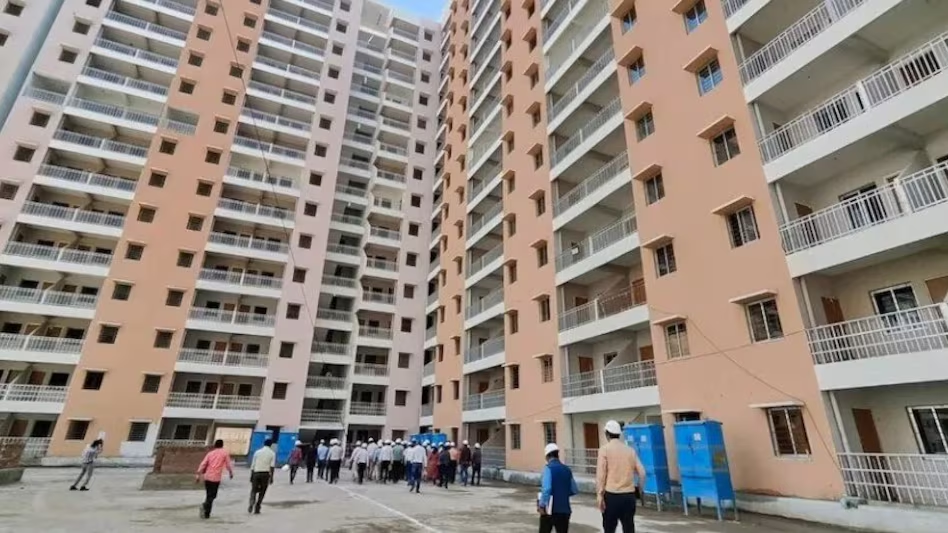
The Union housing ministry is examining a new financing pathway for affordable homes by routing capital through charitable institutions, a move aimed at unlocking funds for economically weaker sections that struggle to secure traditional bank lending.
Speaking at an industry conclave in the capital, the Union Housing and Urban Affairs Minister indicated that philanthropic structures, supported in part by corporate social responsibility (CSR) contributions, could be encouraged to channel funds into low-income group (LIG) and economically weaker section (EWS) housing. The proposal emerges amid persistent credit constraints in the affordable segment, where commercial lenders often cite low margins and higher perceived risk. Officials said the ministry is also considering the creation of a dedicated fund to revive stalled residential projects approved before the implementation of the Real Estate (Regulation and Development) Act, 2016. Such a mechanism could operate alongside or expand the existing SWAMIH framework, which was designed to provide last-mile funding to incomplete housing schemes. Industry representatives have urged the government to scale up intervention to address legacy delays that continue to affect thousands of homebuyers. In parallel, policymakers are deliberating a redevelopment framework for approximately 700-750 slum clusters in and around the National Capital Territory. Senior officials confirmed that discussions are underway across multiple government agencies to align land use, rehabilitation models and financing tools. If executed, the initiative could reshape housing access for vulnerable communities while integrating them more formally into the city’s planning grid.
Experts note that affordable housing remains central to India’s climate-resilient urban agenda. Densification near transport corridors and retrofitting of under-utilised land parcels can reduce commute distances, lower emissions and expand access to services. A senior bureaucrat at the event highlighted that vacant or underused plots in core urban zones could be mapped digitally and repurposed for housing, including rental formats. On land costs, the minister signalled that subsidised land allocation may not be feasible at scale. Instead, cross-subsidisation models where premium development offsets affordable components are being examined, subject to consensus among stakeholders. Such structures have been used in mixed-income townships but require clear policy design to ensure viability without distorting markets. Rental housing also featured in the discussions, with officials indicating that feasibility assessments are ongoing. Urban economists argue that a structured rental ecosystem could address migrant and young workforce needs while preventing informal settlements from expanding.
As India targets long-term economic transformation by 2047, housing policy is increasingly linked to broader growth metrics. Whether through charitable funding vehicles, revival funds for stalled projects, or slum redevelopment frameworks, the coming months will determine how effectively these proposals translate into scalable, transparent solutions for the urban poor.
Also Read: Bengaluru ED attaches Rs 1695 crore assets
Delhi affordable housing fund via charities
