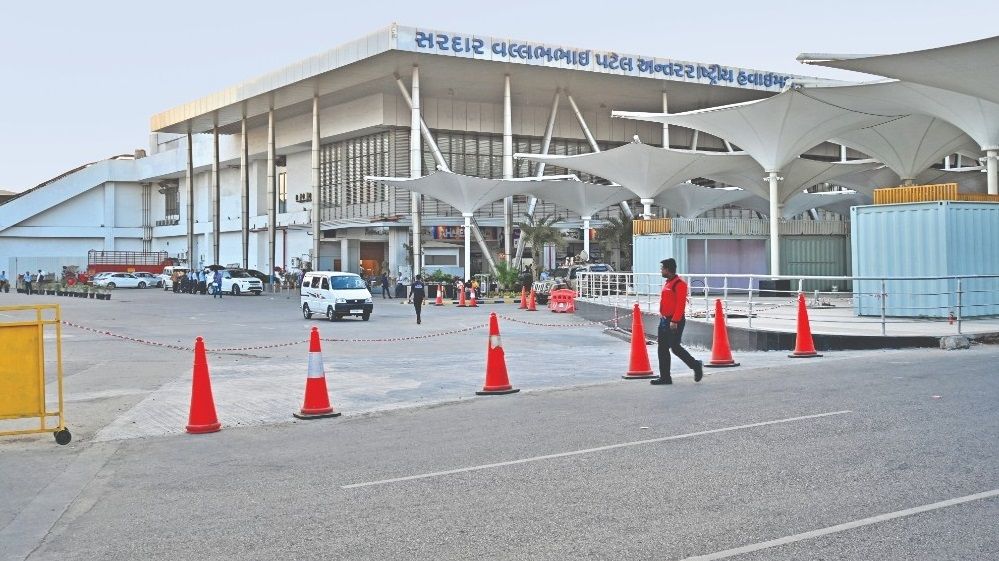
Ahmedabad Surat Airports See Surge In Drug Seizures
Gujarat’s major airports are witnessing a sharp increase in high-value drug seizures, raising concerns about emerging narcotics transit corridors in urban transport hubs. Over the past 45 days, authorities have confiscated controlled substances worth an estimated ₹70 crore at Sardar Vallabhbhai Patel International Airport in Ahmedabad and Surat International Airport.
At Ahmedabad airport, enforcement agencies intercepted 26 kg of narcotics in the last month and a half. Notably, a single seizure on February 10 involved heroin valued at approximately ₹40 crore, transported by a passenger arriving from Kuala Lumpur. Officials indicated this represents the largest quantity in a single-case interception at the airport in five years, highlighting growing operational risks in urban air mobility nodes. Comparatively, the airport recorded 33 kg of seizures in 2024 and 110 kg in 2025, signalling a persistent trafficking trend. Surat airport has experienced a similar trajectory. Multiple recent seizures involved passengers carrying ganja on Bangkok–Surat flights, including 2 kg and 6.5 kg consignments in early February. Additionally, 3.75 kg of hydroponic cannabis was found unclaimed beneath a seat on a flight from Bangkok. Enforcement authorities noted that hydroponic or “hybrid” cannabis is increasingly preferred due to higher tetrahydrocannabinol (THC) content, which amplifies psychoactive effects and makes smaller quantities commercially viable.
Experts point to evolving smuggling tactics as a central challenge. Despite enhanced screening and customs vigilance, traffickers are reportedly diversifying their approach, increasingly relying on female carriers. Data from the past year suggests that women now constitute a significant share of arrested traffickers, reflecting wider shifts in illicit logistics within city airports. Urban planners and security analysts emphasise that these trends have broader civic and economic implications. Airports are critical nodes in urban infrastructure and trade, and rising narcotics trafficking could strain enforcement resources, affect operational safety, and undermine public confidence. Moreover, such activity can indirectly impact real estate and commercial development near transport hubs, where security and regulatory oversight are closely intertwined with investment decisions.
A senior enforcement official noted that proactive monitoring, intelligence-led operations, and inter-agency collaboration are essential to mitigate these risks. Analysts suggest that integrating smart surveillance, advanced scanning technologies, and gender-sensitive profiling could improve interdiction efforts while maintaining passenger flow efficiency. As Gujarat’s airports continue to grow alongside regional economic expansion, the need for resilient, secure, and people-focused infrastructure becomes more pressing. Strengthening controls against illicit flows is critical not only for law enforcement but also for sustaining equitable, safe urban development in rapidly expanding metropolitan corridors.