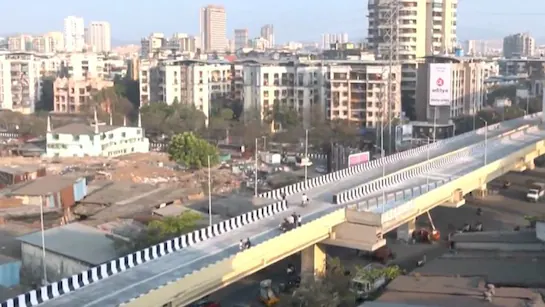
Mumbai Region Plans Phased Opening Of Mira Bhayander Flyover
In a move to improve urban mobility in one of the Mumbai Metropolitan Region’s (MMR) most congested corridors, the Mumbai Metropolitan Region Development Authority (MMRDA) has outlined plans for a phased opening of the Mira Bhayander flyover, with initial operation limited to a single lane in each direction. The phased approach follows a comprehensive safety audit and reflects a growing priority to balance rapid infrastructure delivery with risk management, commuter safety and system resilience.
The flyover — a major elevated link intended to ease traffic between Mira Road and Bhayander — has been under construction for several years, aiming to provide relief to daily commuters facing chronic congestion along ground-level arterials. With urban expansion in the region accelerating, road networks frequently struggle to keep pace with rising vehicle ownership, sprawling residential developments and dense commercial activity. A thoughtful, audit-driven opening process represents a strategic pivot toward data-informed infrastructure governance in India’s largest metropolitan regions.The MMRDA has engaged independent safety professionals to conduct thorough reviews of structural integrity, load performance and traffic management protocols before the flyover is opened to the public. This audit is expected to assess critical components such as pavement quality, drainage systems, lighting, crash barriers and pedestrian walkways, ensuring that even early limited usage adheres to safety standards. Transport specialists say that phased openings provide authorities with a controlled environment to observe real-world usage before full-scale commissioning.
“The initial one-lane-each-way approach allows us to calibrate operations and maintain high standards for user safety,” said a senior MMRDA official. “It’s essential that we synchronise construction completion with advanced traffic engineering.” The authority has indicated that additional lanes will be opened progressively as evaluations and minor adjustments are finalised.While residents largely welcomed the announcement, some local commuters stressed the need for supporting measures such as regulated bus priority, better signage, adequate lighting, and enforcement of traffic discipline on and around the structure. Urban mobility experts argue that flyovers, while significant in reducing surface congestion, should be integrated with broader multimodal networks — including public transport and non-motorised corridors — to achieve sustained improvements in urban travel times and quality of life.
The phased scheme also points to an emerging governance trend: deploying staged infrastructure openings to reduce risk and enhance public confidence. In contexts where rapid construction is often prioritised over operational preparedness, the safety audit requirement introduces a procedural safeguard that could serve as a model for other metropolitan authorities. Such measures align with global best practices in infrastructure delivery, where pre-opening inspections and simulations are standard for elevated and high-traffic structures.Thane district’s urban planners explain that flyover projects must also account for changing land use patterns and traffic flows. As new residential and employment centres take shape, fixed asset investments like overpasses must be adaptive — connecting seamlessly to surface roads, arterial links and pedestrian pathways. The Mira Bhayander flyover’s phased opening can provide real-time data on usage patterns, helping planners refine feeder routes, signal timings and traffic calming interventions nearby.
For logistics operators and commercial commuters who traverse this corridor daily, even limited opening could offer immediate benefits — shorter travel times, reduced fuel costs and improved reliability. However, the degree to which these gains are realised will depend on coordinated traffic management across the network and ongoing stakeholder communication.The MMRDA has committed to publishing audit findings and a lane-opening schedule in the coming weeks, offering transparency into the decision-making process. Urban governance advocates say this step is crucial for building trust and ensuring that infrastructure achievements translate into tangible quality-of-life improvements for residents across the fast-growing MMR.