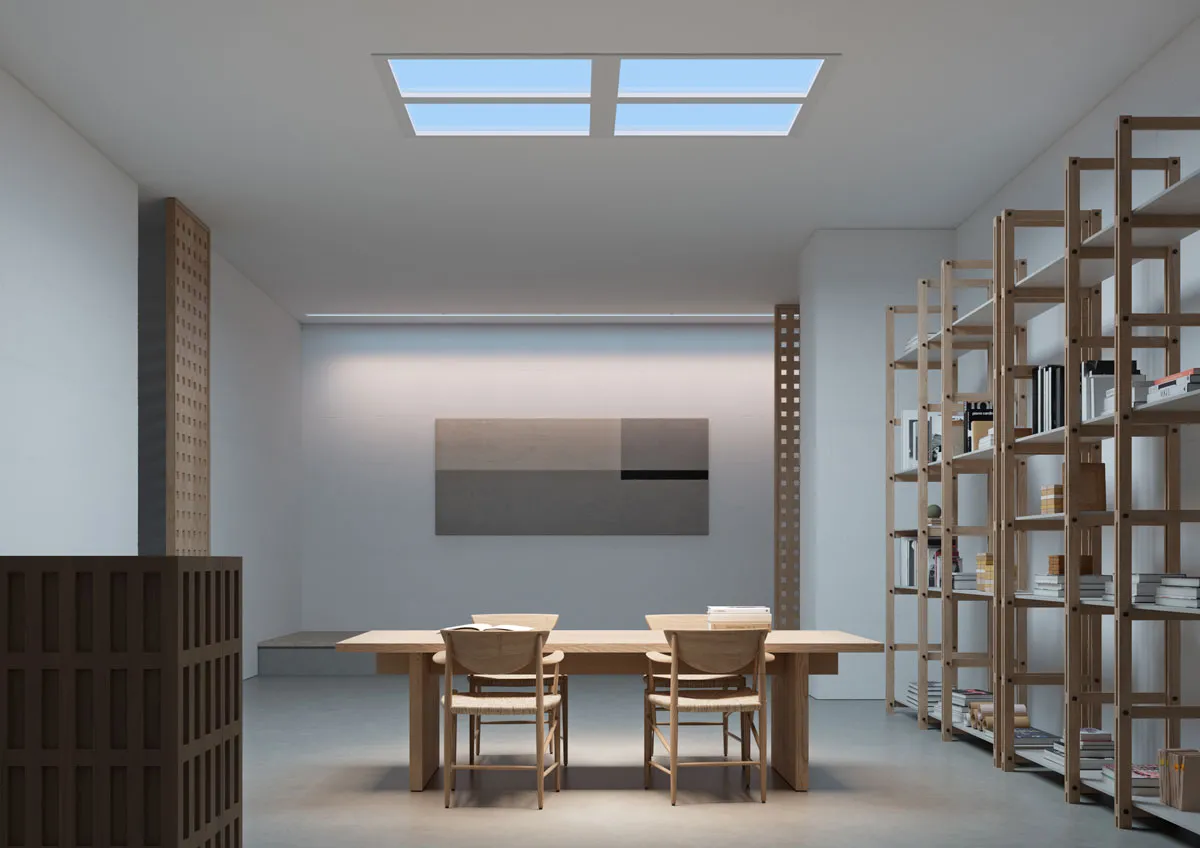
A leap in interior lighting technology is positioning artificial daylight as a design-led tool for healthier and more sustainable indoor environments, following the launch of Coelux High-Tech 25 Mini by Sources Unlimited. The system reproduces sunlight spectra to mimic natural daylight inside interiors — a development of relevance for real estate developers, architects, and urban planners aiming to enhance occupant wellbeing and energy efficiency within medium-to-high density housing and commercial spaces.
Coelux 25 Mini channels advanced optical and LED technologies to simulate “virtual skylights” that visually emulate sunlight — a feature particularly prized in spaces without adequate natural illumination, such as interior rooms, basements or deep plan offices. The system’s compact profile and modular design allow integration into multiple built environments, offering designers a tool to improve spatial quality without the need for extensive structural modifications. This trend reflects a growing recognition in urban design that lighting quality substantively affects occupant comfort, productivity, and even mental health — especially in densely built neighbourhoods where access to daylight can be limited. In many Indian cities, rapid vertical development and constrained urban plots often limit the quantity of daylight penetrating interior zones. Traditional strategies like atriums, light wells, and large glazed façades improve illumination, but urban density and cost pressures constrain their feasibility. Technology-driven solutions like Coelux’s daylight simulation are being seen as complementary options that help align design outcomes with wellness-centric and sustainable design standards, without adding structural bulk.
Urban planners point out that daylight optimisation is not merely an aesthetic choice, but a performance criterion increasingly connected to green building ratings and occupant wellbeing. Research in built environment studies shows that access to daylight — or its accurate simulation — can reduce reliance on artificial lighting, lowering electricity consumption during daytime hours and supporting energy-efficient building operation goals. With more real estate projects pursuing green certification — including LEED, GRIHA, IGBC, and international equivalents — daylighting strategies remain high-priority design components.The Coelux High-Tech 25 Mini is engineered to deliver a broad spectrum light output with a high colour rendering index (CRI), closely resembling genuine sunlight. Developers and architects involved in pilot installations report that this technology enriches interior aesthetics while helping reduce occupant eye strain — a notable advantage in residential units, corporate office floors, and retail environments where user comfort directly influences space utilisation and productivity.
From a sustainability standpoint, enhanced daylighting — real or simulated — supports carbon-efficient building operations by lowering dependence on artificial lighting loads. This contributes to broader climate resilience strategies within urban real estate portfolios, where operational emissions are coming under scrutiny amid net-zero pledges by developers and corporates. Combined with advanced façade systems, the Coelux solution can help buildings generate measurable reductions in energy use over the lifespan of the asset.Design professionals also highlight the psychological impact of better lighting. Enhanced illumination correlates with improvements in occupant mood and circadian rhythm regulation — factors especially pertinent in high-rise living where access to natural light can be compromised on lower floors or internal corridors. Integrating daylight simulation systems into early design phases is increasingly becoming a consideration in comprehensive wellness-oriented architecture.
Still, challenges remain in scaling adoption across affordable housing segments and large-scale developments where cost-benefit analyses weigh heavily on material choice decisions. As technologies like Coelux mature and economies of scale improve, early adopters among premium residential and commercial developers may pave the way for broader market penetration.As urban environments continue to densify, innovations that enhance indoor environmental quality — whether through design, material, or technology interventions — will play a greater role in shaping healthy, sustainable and resilient built environments.