


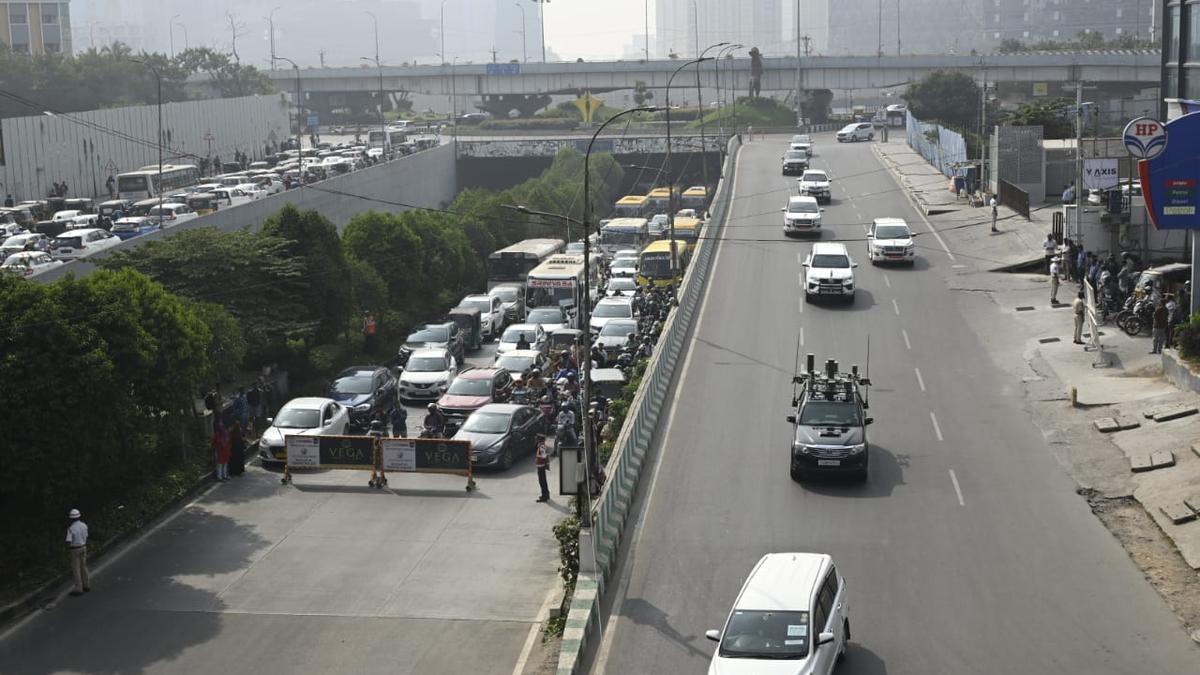
Authorities in Cyberabad have activated a coordinated Madhapur traffic decongestion plan to address mounting gridlock across the HITEC City commercial belt, one of Hyderabad’s most economically productive zones. The intervention targets the Lemon Tree–Trident–Shilparamam corridor, a stretch that carries over one lakh commuters daily and has emerged as a choke point for office-goers, residents and service traffic.
Senior officials from municipal administration, water utilities, traffic police, irrigation, electricity and industrial infrastructure agencies conducted a joint field review this week to synchronise road expansion and utility relocation works. The multi-agency format aims to prevent the delays that typically arise when departments execute parallel infrastructure upgrades in isolation.At the centre of the Madhapur traffic decongestion plan is phased road widening, alongside systematic shifting of underground utilities. Authorities confirmed that a 1000 mm diameter sewer trunk line is nearing completion in the area. The pipeline is designed to prevent sewage overflow into nearby green spaces and water bodies during heavy rainfall — a recurring issue that has compounded both traffic disruptions and environmental stress.
The corridor sits adjacent to Durgam Cheruvu and dense IT campuses, where high-rise development has intensified over the past decade. Urban planners note that while commercial growth has transformed HITEC City into a major employment hub, road capacity and drainage infrastructure have struggled to keep pace.To complement road engineering works, flood drain construction is underway to manage stormwater runoff and reduce monsoon flooding risks. Officials indicated that treated wastewater reuse has been mandated across large commercial complexes in the zone to reduce freshwater extraction and improve water cycle management.
Transport experts argue that while widening roads may ease immediate congestion, long-term relief depends on integrating land use with public transport. The Madhapur–HITEC City stretch is served by metro corridors, yet last-mile bottlenecks and signal congestion limit efficiency gains. Experts suggest bus priority lanes, staggered office timings and pedestrian infrastructure upgrades should form part of the next phase.Environmental analysts also caution that impermeable surfaces and dense construction amplify heat stress in the corridor. Infrastructure upgrades must therefore incorporate climate-sensitive design, including permeable pavements and improved tree cover where feasible.
For businesses operating in the technology district, smoother mobility could enhance productivity and logistics efficiency. However, sustained benefits will hinge on maintenance discipline and traffic enforcement once construction concludes.Officials expect phased completion of key utility and carriageway works over the coming months. As Hyderabad’s western growth corridor continues to expand, the success of the Madhapur traffic decongestion plan will depend on whether infrastructure delivery remains coordinated, data-driven and aligned with long-term sustainability goals rather than short-term capacity expansion alone.
Also Read:India Reviews Height Norms For Urban Growth
Hyderabad Madhapur Traffic Decongestion Plan Rolled Out
