


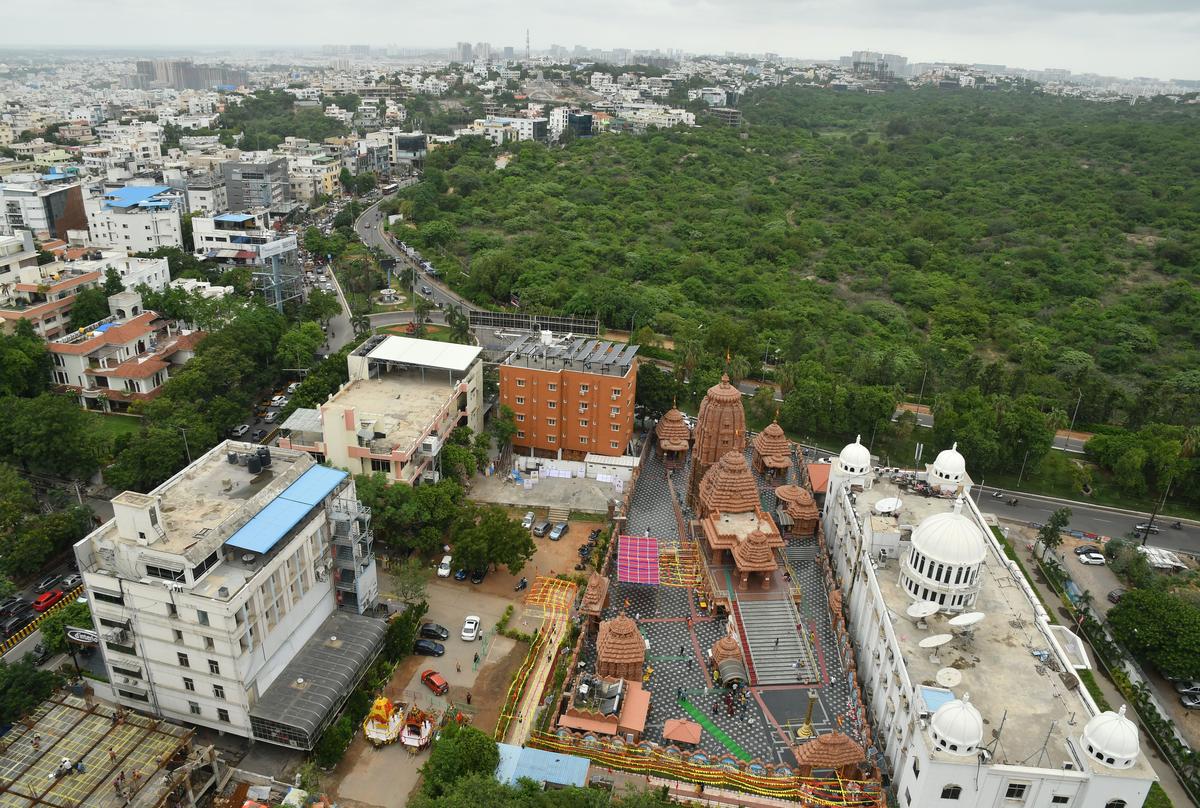
Hyderabad’s civic authorities are set to commence construction under the KBR Park Package II project, a ₹510 crore road infrastructure programme targeting four high-traffic junctions around the city’s central green lung. The works, scheduled to begin in the coming week, form part of a broader urban mobility strategy aimed at easing chronic congestion in the Banjara Hills and Jubilee Hills corridor.
Officials from the Greater Hyderabad Municipal Corporation (GHMC) conducted site inspections along key stretches bordering KBR Park, reviewing preparatory arrangements before ground activity begins. The Hyderabad KBR Park Package II project will introduce a series of flyovers and underpasses at Road No. 45 Junction, Film Nagar Junction, Maharaja Agrasen Junction and the Cancer Hospital Junction — intersections that experience significant peak-hour bottlenecks.Urban planners note that these junctions serve as critical connectors between residential neighbourhoods, commercial districts and institutional clusters. Traffic density in this zone has increased steadily over the past decade due to mixed land use patterns, high-end residential growth and expanding healthcare and hospitality establishments.
The Hyderabad KBR Park Package II works follow an earlier package that addressed mobility constraints at Jubilee Hills Check Post, the KBR entrance and Mugdha Junction, with an outlay of ₹580 crore. Together, the two packages represent one of the city’s more expensive inner-urban traffic decongestion initiatives in recent years.While flyovers and grade separators can improve vehicular throughput, mobility experts emphasise that such infrastructure must be aligned with long-term sustainability objectives. Elevated corridors can redistribute traffic flows, but without complementary public transport enhancements and pedestrian-friendly design, congestion often shifts rather than disappears.
Environmental observers are also closely monitoring developments around KBR Park, which functions as a biodiversity hotspot and recreational space. Construction sequencing, dust mitigation and stormwater management will be crucial to ensure minimal ecological disruption. Officials indicated that engineering teams have been instructed to implement protective measures during excavation and piling phases.Real estate analysts suggest improved junction capacity could influence property values in adjoining micro-markets, particularly in premium residential belts. However, they caution that infrastructure-led appreciation must be accompanied by urban design safeguards to prevent excessive densification and strain on civic utilities.
Transport researchers further argue that long-term congestion management in central Hyderabad will depend on integrating flyover projects with metro connectivity, bus prioritisation and non-motorised transport corridors. Road widening alone may not address structural mobility gaps if private vehicle growth continues unchecked.Construction timelines and traffic diversion plans are expected to be announced shortly. For residents and commuters navigating the KBR Park stretch daily, the coming months will test how effectively Hyderabad balances infrastructure expansion with environmental stewardship and liveability considerations.
Also Read:Central Railway Adds Weekly Trains Between Mumbai Prayagraj
