


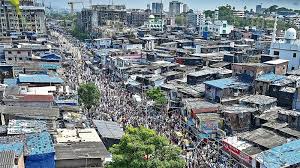
An official inquiry has been initiated in Mumbai after allegations surfaced that newly erected or partially demolished structures in Dharavi were declared eligible for rehabilitation housing. The development has prompted the Slum Rehabilitation Authority (SRA) to order a probe into beneficiary records linked to the Dharavi redevelopment, raising broader questions about data integrity, fairness, and governance in one of Asia’s largest urban renewal projects.
The inquiry centres on Shatabdi Nagar, a settlement abutting the Loop Road within Dharavi. Nearly a decade ago, the Maharashtra Housing and Area Development Authority (MHADA) surveyed approximately 800 hutments in the area as part of a redevelopment plan and shifted several hundred families to rehabilitation towers. However, complaints now suggest that some vacated structures were not fully cleared, enabling fresh occupation in subsequent years. According to documents reviewed by Urban Acres, concerns have been raised that certain structures not reflected in legacy survey maps were subsequently listed as eligible units. In some cases, housing identification numbers appear to have been duplicated with minor modifications, prompting doubts about verification protocols. Officials overseeing the Dharavi Redevelopment Project (DRP) confirmed that a detailed review is underway. They described the verification process as complex, involving legacy surveys conducted by multiple agencies over different periods. A final report is expected to clarify discrepancies and outline corrective steps, though no timeline has been publicly announced.
The redevelopment of Dharavi now overseen by Navbharat Mega Developers Pvt Ltd, a state-backed special purpose vehicle is financially and socially significant. The project seeks to rehabilitate eligible residents into formal housing while unlocking land value to fund infrastructure and commercial components. Any irregularities in eligibility determination could alter rehabilitation counts, escalate costs, and trigger legal challenges. Urban planners note that beneficiary identification is the backbone of slum redevelopment economics. Inaccurate or outdated records can distort rehabilitation entitlements and undermine public trust. Transparent digital mapping, tamper-proof surveys, and geo-tagged verification have increasingly become standard practice in large-scale urban renewal to prevent re-encroachment and duplication. Beyond administrative concerns, the episode underscores the human dimension of housing transitions. Families awaiting allotment may perceive inequity if newer occupants are prioritised, potentially fuelling social friction in already dense settlements.
As Mumbai advances towards more inclusive and climate-resilient urban regeneration, governance safeguards will be critical. Clear eligibility criteria, time-bound disclosures, and independent audits could strengthen confidence in redevelopment outcomes. For Dharavi often cited as a test case for equitable transformation the credibility of the housing eligibility process may ultimately shape both investor sentiment and community acceptance.
Also Read: Mumbai CREDAI MahaCON Real Estate Outlook
Mumbai SRA Probes Dharavi Housing Eligibility
