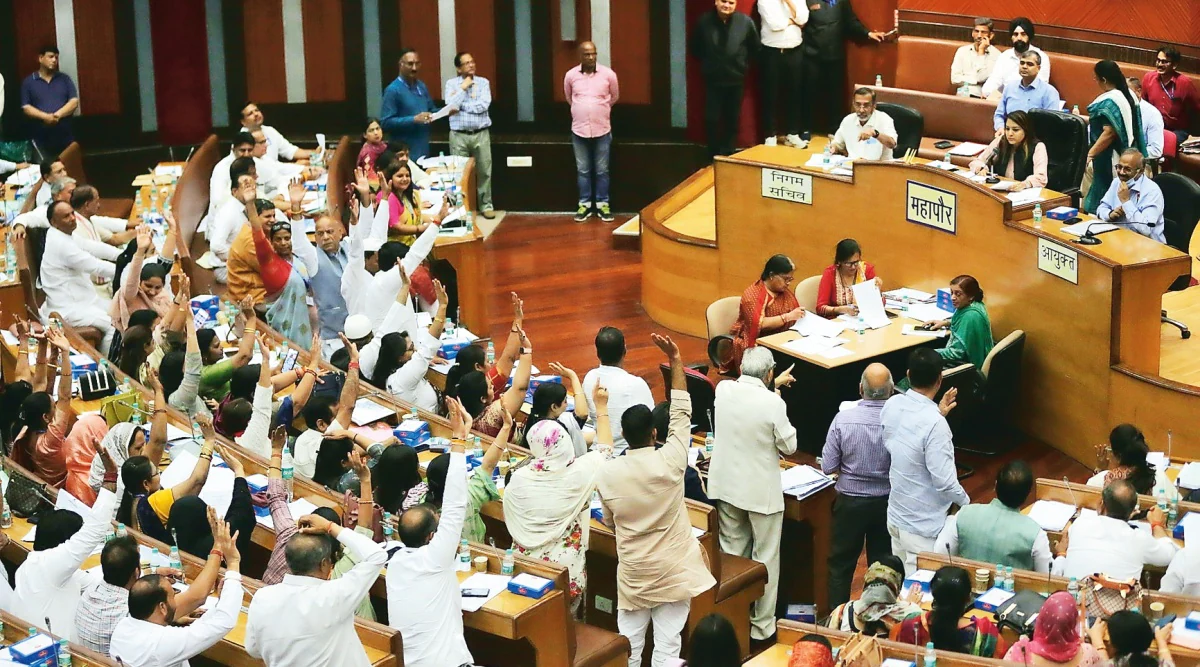
Delhi’s civic administration has approved a ₹17,583 crore expenditure plan for 2026–27, with sanitation and education emerging as the two largest focus areas in what officials describe as the corporation’s most expansive financial blueprint to date. The Delhi MCD Budget, cleared at a special house meeting, projects revenues of roughly ₹18,000 crore, signalling a marginal surplus while placing core urban services at the centre of spending.
Nearly ₹4,800 crore the single largest allocation has been earmarked for sanitation and solid waste management. The outlay includes procurement of mechanised road sweepers and litter collection equipment across wards, as well as continued work on legacy landfill remediation. Civic officials have set timelines to eliminate waste mounds at Bhalswa and Okhla within the year, with the long-pending Ghazipur site targeted for phased clearance by 2027.
Urban environment experts say the scale of sanitation spending reflects mounting pressure to address landfill fires, methane emissions and groundwater contamination issues that have direct public health and climate implications. They note that the Delhi MCD Budget’s focus on mechanisation may improve operational efficiency, but sustained segregation and decentralised waste processing remain critical to prevent future dumping crises.
Education has been allocated more than ₹3,260 crore, alongside a separate provision for school repair and maintenance. Municipal schools will receive funds for infrastructure upgrades, while accident insurance coverage for students is set to increase. Analysts point out that investment in school facilities is closely tied to neighbourhood liveability and property values, particularly in lower- and middle-income wards where municipal institutions anchor social mobility. Public health and medical relief have received close to ₹1,926 crore, with plans to expand primary healthcare facilities in coordination with the state government. The budget also outlines a cashless treatment framework for civic staff and pensioners under central health scheme rates, reflecting efforts to standardise welfare provisions within municipal governance.
On the revenue side, the corporation has introduced targeted property tax relief measures, including exemptions for specified residential categories in designated rural and urban village zones, and incentives for group housing societies that pay dues on time. Real estate consultants say such measures may ease compliance burdens, though long-term fiscal sustainability will depend on improving collection efficiency across the tax base. Additional allocations cover engineering works, horticulture and veterinary services, alongside grants to residents’ welfare associations for neighbourhood maintenance. Financial support schemes for widows, single parents and persons with disabilities have also been retained at the ward level.
Urban planners observe that the Delhi MCD Budget signals a shift towards service delivery and environmental management rather than large-scale capital expansion. The challenge ahead lies in translating allocations into measurable outcomes cleaner streets, safer schools and reduced landfill footprints while maintaining fiscal discipline. As Delhi grapples with rapid urbanisation and climate stress, municipal spending choices will increasingly shape whether the capital moves towards a more resilient, equitable and low-emission urban future.
Delhi MCD Budget Prioritises Sanitation Push