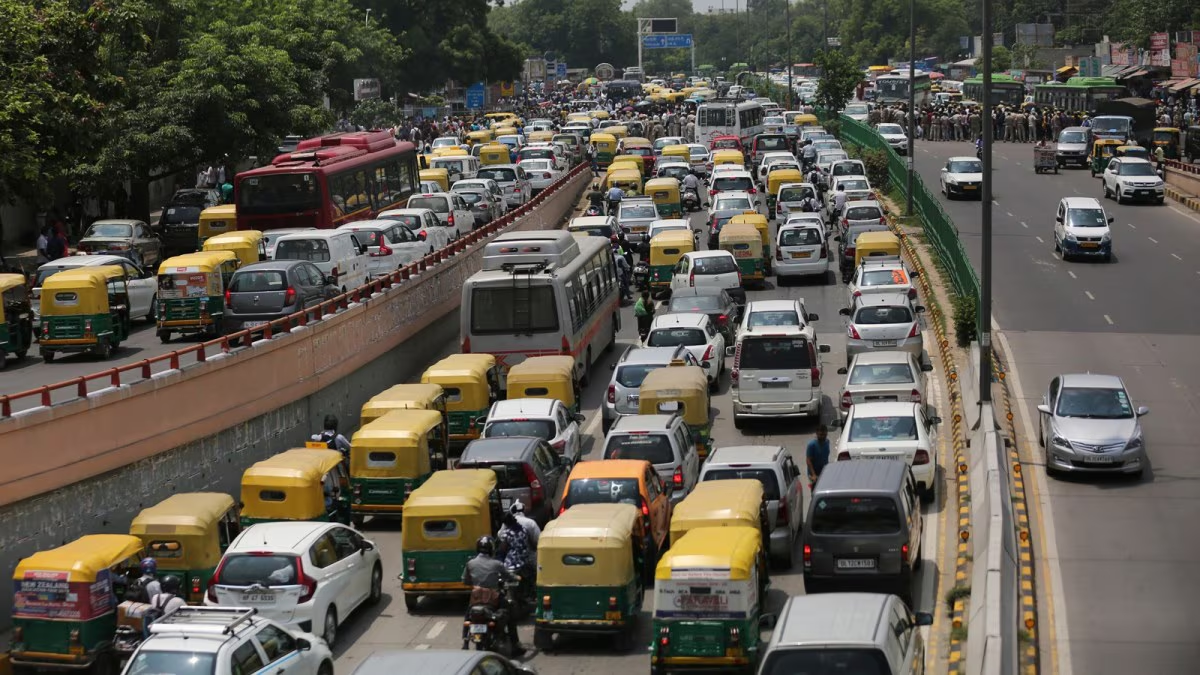
Delhi is preparing a new round of large-scale road interventions aimed at easing chronic congestion across some of its most overburdened corridors, as the Public Works Department (PWD) lines up a slate of Delhi traffic decongestion projects for the 2026–27 fiscal year. The proposed works, currently under internal review, are expected to form part of the city’s upcoming budget roadmap and could significantly reshape connectivity between North, South and outer districts.
Senior officials indicate that the programme focuses on arterial stretches where traffic density, mixed land use and regional movement intersect. These include the 47-km Outer Ring Road loop, key entry points to Old Delhi, and links connecting Delhi to Gurugram, Noida and Haryana’s industrial belt. Urban planners say these corridors are not just commuter routes but economic lifelines, carrying freight, airport-bound traffic and inter-state movement.
Among the most significant proposals is an elevated corridor running parallel to parts of the Outer Ring Road, designed with controlled entry and exit points to streamline through-traffic. With more than a dozen high-load junctions, the route currently handles sustained peak-hour congestion. Experts note that grade separation and access management could reduce idling time a key contributor to vehicular emissions. In north Delhi, authorities are examining the extension of an existing underpass near Mukarba Chowk towards Sanjay Gandhi Transport Nagar, an area dominated by truck traffic and warehousing. Improved grade separation in this freight-heavy belt is expected to ease pressure on GT Karnal Road and the Singhu border corridor, which serve both logistics and regional commuter flows.
South Delhi features prominently in the Delhi traffic decongestion projects blueprint. Elevated links and integrated corridor redesign are under consideration along stretches of Mehrauli-Badarpur Road and Aurobindo Marg both dense urban spines that connect residential zones, hospitals, institutional clusters and metro interchanges. Transport analysts argue that redesigning these stretches must integrate pedestrian safety, bus priority measures and drainage upgrades to ensure long-term resilience. Additional proposals include bridge infrastructure across the Yamuna to improve access to trans-river neighbourhoods, a new flyover linking Zakhira with Anand Parbat’s industrial area, and an underground tunnel alignment connecting NH-8 with Dwarka. Authorities are also reviewing congestion mitigation along Mathura Road and the Ring Road-ITO belt, where traffic from central administrative zones merges with east Delhi flows.
While feasibility studies and detailed project reports are yet to be commissioned, infrastructure experts caution that road expansion alone cannot solve Delhi’s mobility challenges. They emphasise synchronising these projects with public transport upgrades, freight rationalisation and climate-sensitive design.
If implemented with integrated planning, the proposed interventions could reduce travel time, cut fuel wastage and enhance regional economic efficiency outcomes that matter not only for mobility but for Delhi’s long-term transition towards a more resilient and low-emission urban future.
Delhi Plans Major Traffic Decongestion Push