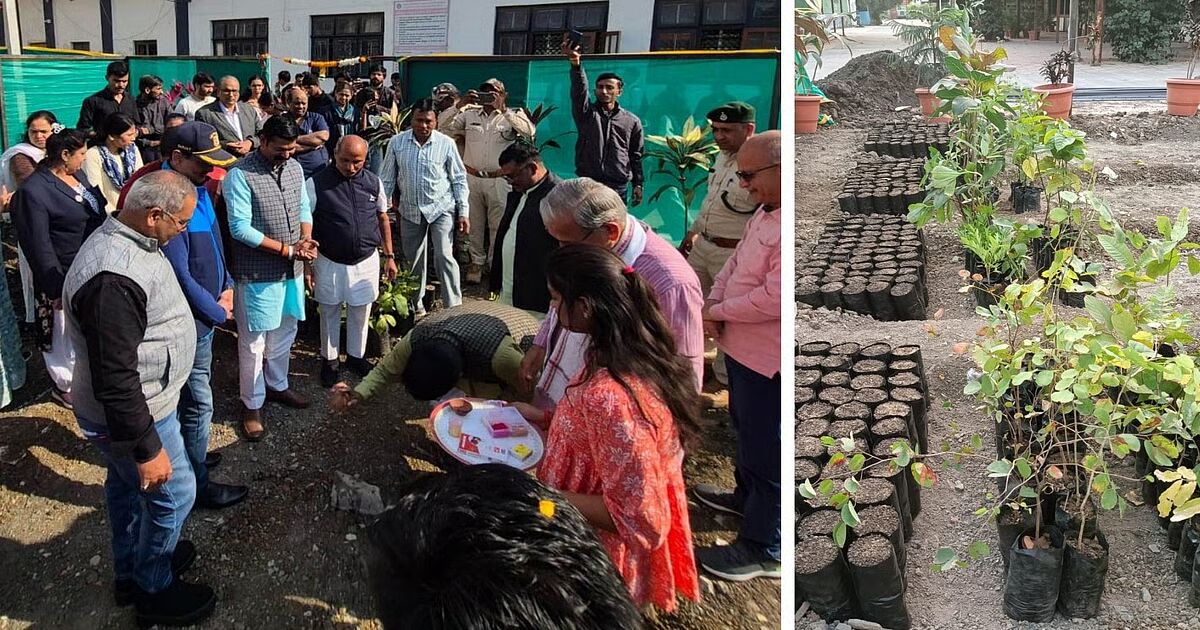
Indore Urban Forest Project Boosts Biodiversity And Resilience
An engineering institute in Indore has repurposed one of the city’s most valuable land parcels into a dense urban forest using the Japanese Miyawaki afforestation technique, demonstrating how educational campuses can lead community-scale climate action in rapidly urbanising regions.
The Miyawaki grove — planted two years ago and now maturing into a multi-layered green habitat — offers a model for embedding biodiversity and micro-climate improvements into urban fabric. The dense forest, inaugurated recently on the institute’s Race Course Road campus, spans a full acre within a 30-acre campus in a highly congested neighbourhood. Urban land values in this area are estimated at around ₹100 crore per acre, making the decision to develop a forest rather than commercial infrastructure noteworthy for its social and environmental intent. Using the Miyawaki ecological method — which involves planting a mix of native species close together to accelerate growth and ecological complexity — more than 8 000 saplings from 65 species, including 25 classified as endangered, were planted across the site.
Experts call this approach effective for creating dense, biodiverse green cover in limited space and for rapidly shaping forest-like ecosystems in urban contexts. Field observations indicate that roughly 90 per cent of the saplings have survived and many have grown into trees reaching 15–20 feet in height. The plantation was supported by drip irrigation and entirely organic manure, underscoring how low-impact cultivation practices contribute to healthier urban ecosystems with reduced chemical load. Urban planners say dense micro-forests like these create localized ecological benefits, including improved air quality, enhanced biodiversity habitat and cooler micro-climates, contributing to cities’ broader climate adaptation strategies. Dense vegetation can absorb more carbon dioxide and particulate pollution per square metre than sparsely planted roadside trees, and encourages soil moisture retention — all critical factors in heat-prone Indian cities.
Beyond environmental gains, the Indore initiative has social implications. Projects on institutional land can act as demonstration sites for neighbourhood residents, catalysing community interest in afforestation and sustainable land use. In areas where built density limits conventional park development, compact Miyawaki forests offer a scalable alternative to expand green cover.The project was supported largely through corporate social responsibility funding, with a local bank providing the bulk of the cost. Annual maintenance is budgeted modestly, reflecting how such urban greening interventions can be cost-effective when integrated into institutional planning.
Experts note that while Miyawaki forests require careful early-stage maintenance, they tend to become self-sustaining after a few years, reducing long-term resource demands. For policymakers and civic planners, this points toward an urban resilience strategy that blends ecological restoration with land-use planning, especially in dense neighbourhoods where green space is scarce.