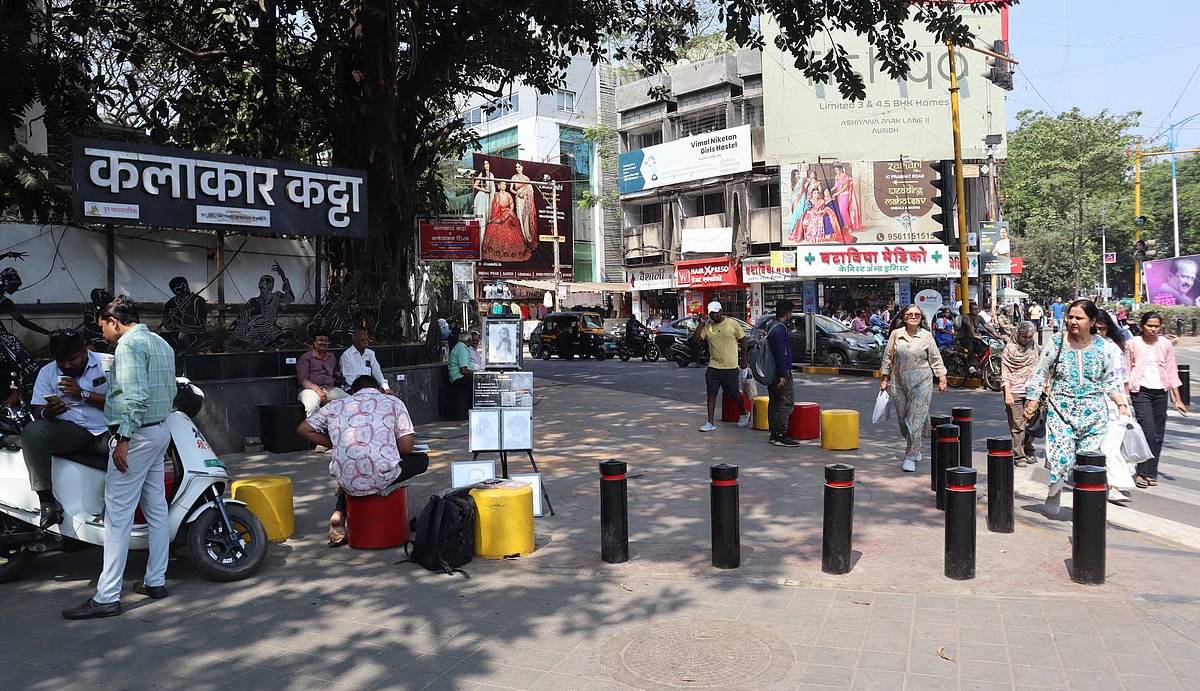
Pune Municipal Corporation (PMC) has initiated the relocation of the informal artists’ space near a popular Fergusson College Road café to address mounting traffic congestion at Gokhale Chowk, one of the city’s most heavily used intersections. The decision follows assessments by municipal officials highlighting that the existing setup, originally permitted on the footpath, restricts turning space for buses and heavy vehicles, exacerbating gridlock during peak hours.
Urban planners note that Gokhale Chowk functions as a critical node connecting multiple residential and commercial corridors in Deccan Gymkhana, a precinct with narrow streets dating back to the early 20th century. Vehicles converging from adjacent neighbourhoods often encounter bottlenecks, creating delays that ripple across the city’s public transport network. The artists’ seating and display area, while intended to enhance public engagement and footpath utilisation, has inadvertently contributed to these operational challenges.
City transport experts emphasise that the relocation aligns with broader traffic optimisation goals in dense urban centres. “In legacy areas with constrained road widths, even small encroachments can have disproportionate effects on bus schedules and emergency vehicle access,” said a senior official from PMC’s traffic planning division. Clearing the obstruction is expected to improve average vehicle speeds and reduce stoppage times for buses along the Fergusson College Road–Bhandarkar corridor. Economic analysts point out that such interventions, though localised, carry wider implications for the city’s business ecosystem. Improved traffic flow at Gokhale Chowk could enhance accessibility for retail, hospitality, and educational institutions in the vicinity, supporting footfall recovery and operational efficiency. Conversely, unmanaged congestion can increase fuel consumption, emissions, and commute times, counteracting Pune’s climate resilience and zero-carbon mobility targets.
Socially, the decision balances urban livability with inclusive public space usage. By relocating rather than eliminating the artists’ space, PMC preserves avenues for cultural engagement while prioritising essential mobility infrastructure. Urban development specialists highlight that such calibrated interventions demonstrate a people-first approach, integrating art, culture, and transport planning within the city’s evolving civic framework.Implementation is expected over the coming weeks, coordinated by PMC’s encroachment and traffic management departments. Planners will monitor the junction post-relocation to assess improvements in traffic circulation and pedestrian safety. This episode underscores the ongoing challenge of harmonising public space initiatives with sustainable urban mobility in historically dense neighbourhoods, reinforcing the need for data-driven, climate-conscious city planning.