


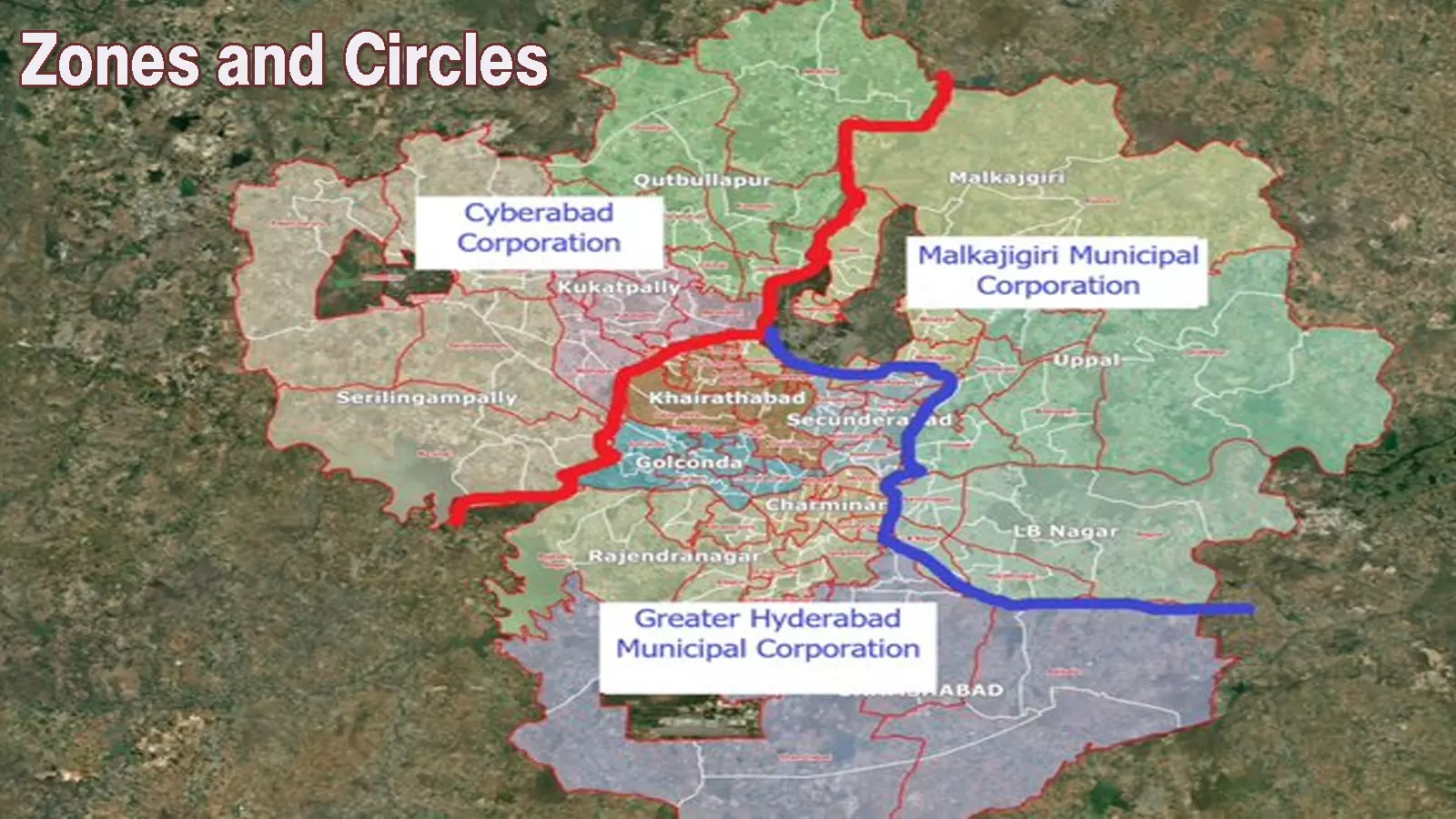
The newly constituted Cyberabad Municipal Corporation is on course to become Telangana’s highest revenue-generating civic body, reshaping Hyderabad’s municipal finance landscape. Early property tax data for 2025–26 indicate that the IT-driven western corridor is outperforming the restructured Greater Hyderabad Municipal Corporation, signalling a decisive shift in urban economic gravity.
Despite comprising just 76 wards, Cyberabad Municipal Corporation has already collected around ₹820 crore in property tax this financial year. By comparison, the 150 wards that now form GHMC have mobilised roughly ₹750 crore so far. Officials project Cyberabad’s collections could touch ₹1,200 crore by the end of March, consolidating its position as the state’s most financially robust urban local body.Revenue concentration is most visible in Madhapur and Serilingampally, two of the city’s highest-yielding tax circles. Together, they account for nearly 15 per cent of the total property tax generated across the wider Hyderabad region. Urban finance experts attribute this to dense commercial development, premium residential layouts and a steady pipeline of high-rise approvals.
Senior municipal officials indicate that strengthening revenue administration will be a priority, including the identification of unassessed and under-assessed properties. Digitisation of property records, integration with electricity databases and streamlined mutation processes are being leveraged to improve compliance and plug leakages.The financial strength of Cyberabad Municipal Corporation stems largely from the IT corridor and associated real estate growth. High-value commercial offices, gated communities and mixed-use developments generate not only property tax but also significant inflows from building permissions, impact fees and development charges. Trade licences and advertisement revenues further enhance its fiscal base.
In contrast, the truncated GHMC is expected to witness a notable dip in revenues after ceding major commercial zones. During 2024–25, the undivided civic body had recorded over ₹2,000 crore in property tax collections, alongside substantial earnings from building-related approvals. With the bifurcation and limited time left in the current fiscal cycle, its receipts are projected to fall sharply.Urban planners say the reorganisation underscores a broader structural question: how to balance fiscal capacity across municipal bodies to ensure equitable service delivery. While Cyberabad Municipal Corporation may have a stronger balance sheet, infrastructure demands in older parts of Hyderabad remain significant, particularly in sanitation, drainage, pedestrian infrastructure and green spaces.
The commissioner-designate has indicated that revenue gains will be channelled towards closing infrastructure gaps, enhancing public amenities and upgrading civic services. Experts note that sustained investment in footpaths, parks, waste management and energy-efficient street lighting will be critical to maintaining liveability as densities rise.As Hyderabad evolves into a multi-nodal metropolis, the fiscal divergence between civic bodies could influence future real estate patterns and infrastructure planning. The challenge for policymakers will be to ensure that revenue buoyancy in growth corridors translates into climate-resilient, inclusive urban development across the metropolitan region.
Also Read:Poulomi Estates Expands Beyond Telangana with Bengaluru Project
Cyberabad Municipal Corporation tops property tax charts
