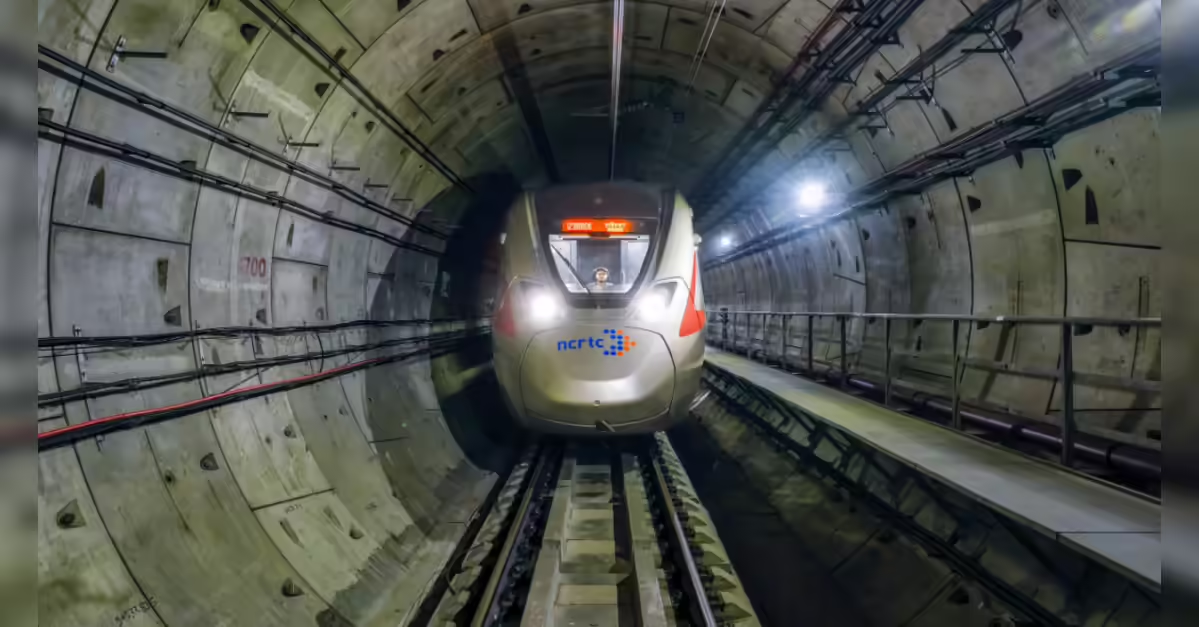
The National Capital Region is on the cusp of activating the entire 82-kilometre Delhi–Ghaziabad–Meerut Namo Bharat corridor, marking a decisive moment for high-speed regional mobility in northern India. Officials associated with the National Capital Region Transport Corporation indicate that statutory clearances are in the final stage, with full operations expected to begin within weeks.
Once commissioned end-to-end, the Delhi–Ghaziabad–Meerut Namo Bharat corridor will connect Sarai Kale Khan in Delhi to Modipuram in Meerut through 16 stations, significantly reducing travel time across one of India’s most densely populated commuter belts. For daily passengers, this shift is expected to alter commuting patterns that currently depend heavily on congested highways and conventional rail. A 55-kilometre section between New Ashok Nagar and Meerut South is already operational and has recorded more than 22 million passenger journeys since services began in October 2023, according to project officials. The remaining segments a five-kilometre stretch in Delhi and a 21-kilometre extension deeper into Meerut are physically complete and awaiting formal inauguration.
The ₹30,274 crore project is India’s first Regional Rapid Transit System, designed to operate at semi-high speeds while maintaining metro-like frequency. Urban mobility analysts say the corridor’s real significance lies in its regional integration model. By linking satellite cities such as Ghaziabad and Meerut with the capital through fast, reliable public transport, the system could influence residential choices, commercial development and logistics planning along the route.
An additional milestone is the introduction of Meerut Metro services on the same infrastructure. This shared-track arrangement where regional and intra-city metro trains operate on common corridors represents a first for India and could offer a template for other metropolitan clusters seeking cost-efficient expansion.
From a fiscal standpoint, the Uttar Pradesh government has made a nominal allocation in its 2026–27 budget as loan support to offset potential operational shortfalls. Categorised under urban development financing, the provision underscores the long gestation period typical of large transport infrastructure, where ridership stabilisation and revenue balancing take time. Transport economists note that high-capacity electric rail corridors such as the Delhi–Ghaziabad–Meerut Namo Bharat corridor contribute to lower per-capita emissions compared to private vehicle use. Over time, modal shifts from road to rail could reduce congestion, fuel consumption and air pollution a pressing concern in the National Capital Region.
Real estate consultants are also tracking the corridor closely. Transit-oriented development around stations is expected to intensify, particularly in Ghaziabad and Meerut, where improved connectivity may attract housing and commercial investment. As the Delhi–Ghaziabad–Meerut Namo Bharat corridor approaches full commissioning, the next challenge will be ensuring seamless last-mile connectivity, fare integration and equitable access. The long-term success of the system will depend not only on speed, but on how well it integrates with the broader urban fabric of the region.
Delhi NCR Namo Bharat Nears Full Launch