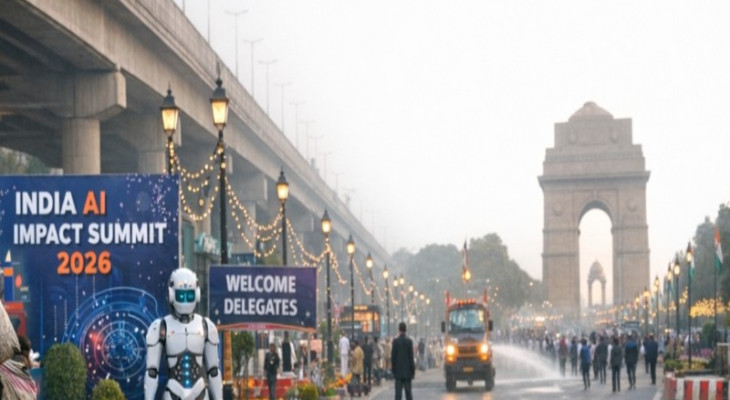
Delhi is undergoing a visible urban reset as it prepares to host the AI Impact Summit 2026 at Bharat Mandapam next week, triggering citywide clean-up operations, security mobilisation and a sharp spike in hospitality demand. While officials frame the summit as a milestone in India’s digital diplomacy, the preparations are also reshaping public spaces and exposing long-standing gaps in urban shelter capacity.
The AI Impact Summit, scheduled between 16 and 20 February, is expected to draw global policymakers, technology leaders and academic institutions. Government officials have positioned the gathering as a platform for emerging economies to shape practical applications of artificial intelligence in governance and industry. For Delhi, however, the event has become an operational stress test spanning infrastructure, social equity and real estate markets. Across key arterial roads leading to central Delhi and the airport, civic teams have intensified sanitation drives, removed informal encroachments and increased surveillance. Multiple agencies including municipal authorities, the public works department and law enforcement are coordinating efforts to ensure uninterrupted traffic movement and high-visibility urban corridors.
These operations have coincided with the relocation of homeless residents from flyovers, pavements and central verges. Independent urban advocacy groups estimate that roughly 300,000 people in Delhi live without secure housing, while permanent night shelter capacity remains below 20,000 beds. Urban development specialists note that temporary relocation to shelters, even when basic amenities are provided, often disrupts fragile livelihood networks tied to informal work clusters near transport corridors and markets. The pattern mirrors previous mega-events, where short-term city beautification measures were prioritised over durable housing solutions. With nearly four-fifths of Delhi’s workforce engaged in informal employment, displacement even if temporary can affect access to daily income, waste recycling networks and street vending locations. Urban planners argue that global summits increasingly demand not only aesthetic upgrades but also long-term rehabilitation strategies if cities are to align event hosting with inclusive development goals.
Parallel to the civic operations, Delhi’s hotel market is witnessing unprecedented demand ahead of the AI Impact Summit. Luxury properties in Lutyens’ Delhi and Aerocity are reporting near-full occupancy, with premium suites priced at multiples of their regular tariffs. Hospitality consultants say the spike reflects structural supply constraints rather than short-term opportunism. Compared with global event hubs such as Singapore or Dubai, Delhi’s high-end room inventory remains limited relative to peak diplomatic demand.
Industry analysts tracking booking data report a several-fold increase in search activity for Delhi during the summit window, underscoring strong international interest. Longer stays, security protocols and corporate block reservations have tightened availability across the top segment. As Delhi positions itself as a convening ground for technology governance in the Global South, the AI Impact Summit is also highlighting the pressures that accompany global visibility. From climate-conscious transport logistics to equitable housing access and resilient hospitality infrastructure, the capital’s preparations illustrate how international events can accelerate both ambition and accountability in urban planning. What remains is whether such interventions translate into systemic upgrades beyond the summit’s closing session.
Delhi Prepares City For AI Impact Summit