


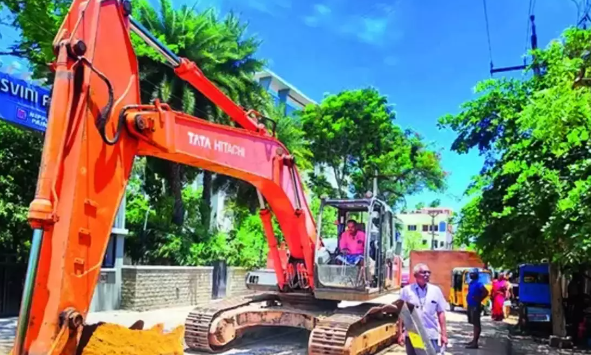
Chennai’s Metropolitan Water Supply and Sewerage Board (Metrowater) is gearing up to significantly enhance water supply infrastructure, benefiting approximately 6.6 lakh residents across several key areas.
Scheduled to commence early next month, the project represents a pivotal step in ensuring reliable and efficient water distribution to urban communities. The areas set to receive piped water include Okkiam Thoraipakkam, Madipakkam, Madhavaram, and Nerkundram, with Metrowater currently conducting final trials and preparations. In Madipakkam alone, where pipeline laying commenced in February 2019, and in Okkiam Thoraipakkam from February 2020, these efforts have culminated in readiness to provide essential water connections. The delay in Madhavaram, attributed to the extensive household connections totaling 3.8 lakh, is set to be resolved with a distribution of 33 million litres per day (MLD). Similarly, Madipakkam and Okkiam Thoraipakkam will receive 25 MLD and 18.18 MLD, respectively. In Nerkundram, recent trials for water supply through piped networks are nearing completion, with plans to service 84,000 houses starting August with 12 MLD of water. This expansion marks a crucial development for local residents, enhancing their daily living standards significantly.
Looking ahead, the Ramapuram area along Mount-Poonamallee Road, which anticipates the opening of Chennai Metro Rail Limited’s phase-2 by 2026, is also slated for water supply upgrades commencing in August. Approximately 90,000 residents will benefit from the provision of 14 MLD of water, alongside the completion of underground drainage connections by July. This integrated approach aims to mitigate environmental impacts by directing 11 MLD of sewage to the Nesappakkam treatment plant, thereby reducing untreated discharge into the Adyar River. Metrowater’s comprehensive strategy underscores its commitment to expanding Chennai’s water infrastructure, catering to growing urban demands and ensuring sustainable development. These initiatives not only promise improved living conditions but also contribute significantly to the city’s overall socio-economic progress.
